
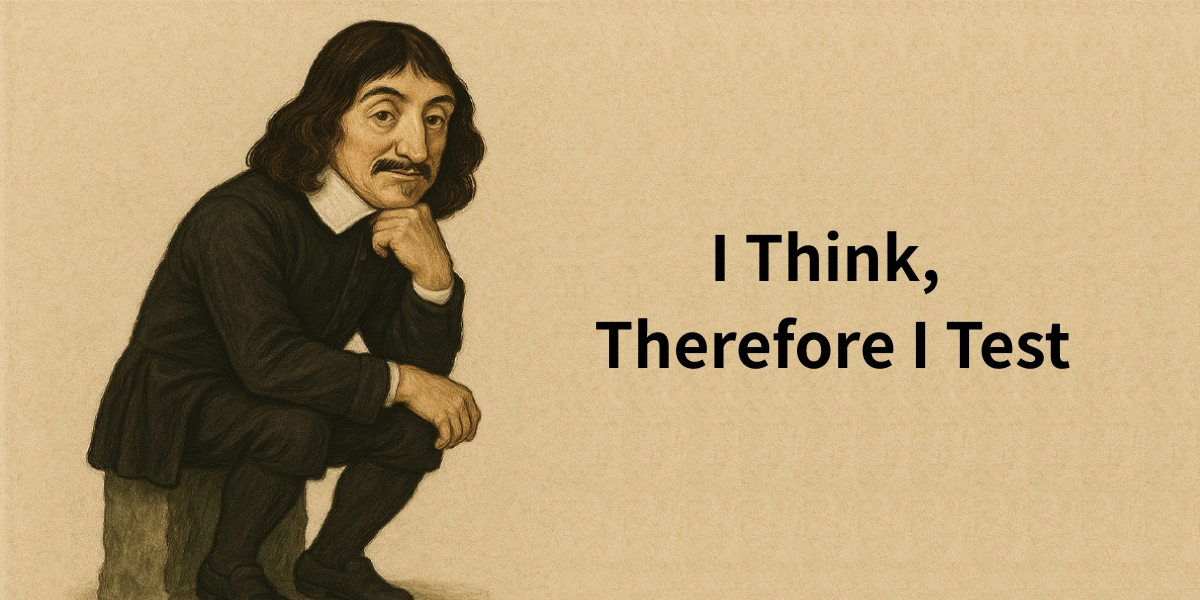
What can a 17th-century philosopher teach us about UX?
Surprisingly, quite a lot.
One of the most famous phrases in philosophy comes from René Descartes:
“I think, therefore I am.”
For him, this wasn’t just proof of existence. It was the starting point of an intellectual journey to find absolute certainty through radical skepticism. Centuries later, this philosophical quest remains surprisingly relevant. In fact, Descartes’ struggle perfectly mirrors the challenges we face in modern product development.
Picture this. A development team spends months building a prototype for a new reservation system. They are absolutely confident in its quality. The flow is intuitive, they say. No one could possibly get confused.
Then comes the first user test.
In an instant, their confidence crumbles. Users behave in completely unexpected ways, failing to reach core features and giving up halfway through. A heavy silence fills the observation room. The team is left wondering what happened to the common sense they believed in.
This moment where certainty collapses is exactly the kind of doubt Descartes experienced. And it is precisely where true UX research begins.
The UX Mindset: Question Everything
To reach the truth, Descartes adopted a stance known as methodological doubt. He stripped away everything he thought he knew, questioning his own senses, his common sense, and even the existence of the desk in front of him. His goal was not destruction, but to discover what remained undeniable after every doubt was exhausted.

This mindset is incredibly effective for overcoming cognitive biases in product development. As creators, we are constantly trapped by the False Consensus Effect where we assume users think like we do, and the Curse of Knowledge where we know the product so well we cannot imagine a beginner’s struggle.
Great UX researchers must be humble skeptics before they can be optimistic creators. Everything starts by questioning our own assumptions and admitting that our hypothesis might be wrong.
The Essence of Usability Testing
Descartes warned that the senses can deceive us. In UX design, this happens every day.

- This button is a different color, so users will definitely see it.
- The meaning of this icon is obvious.
These visual assumptions are easily betrayed by reality. The only thing that rescues us from this trap is usability testing.
Usability testing may seem simple. You just watch real users interact with your product. But in truth, it is a philosophical act that confronts the creator’s assumptions with the user’s reality.
When testing begins, users often ignore information we thought was prominent, misunderstand words we thought were clear, and act on logic completely different from our own. These sometimes brutally honest observational facts are what free us from our assumptions and lead us to the truth.
“Small Certainties” in Observation
After doubting everything, the one undeniable truth Descartes found was his own existence: “I think, therefore I am.”
In UX research, our version of this undeniable truth is observational data. It is not what users say, but what they do.

Certainty 1: Five out of five users completely ignored the filter function. Even though it was always visible on the left, they scrolled endlessly through irrelevant listings.

Certainty 2: Users consistently misunderstood Sync as Backup. They did not understand the cloud-local connection, noting that they would sync it just to be safe so they didn’t lose data. This proves how easily technical jargon fails in a user’s context.
These are observable certainties. Even without statistical significance, these insights provide a solid foundation for design decisions.
Trust Behavior, Not Reason
This approach aligns with the N=5 principle proposed by usability expert Jakob Nielsen, who argued that testing with just five users can reveal 85% of usability problems. We don’t need massive statistics. We need the accumulation of these small certainties.
However, there is a key difference between Descartes and UX researchers. Descartes doubted his senses to find truth in pure reason. Conversely, UX researchers rely entirely on behavior. We trust the actions that emerge through the user’s senses as our starting point.
Instead of starting with grand, beautiful hypotheses, we carefully stack small, observed certainties one by one. This is the only path to building a solid user experience rather than one built on fragile assumptions.
Conclusion: From Certainty to Validation
For us, Descartes’ doubt is a lesson in intellectual humility. It requires us to start with the premise that we know nothing.
Creators inevitably feel the urge to say, “I think this will work.” But just as Descartes questioned his own thoughts, that confidence can be a dangerous trap. That is why we arrive at a new conclusion:
“I think, therefore I test.”
The best UX is born not from conviction, but from validation.
At Uism, we embrace this Cartesian spirit. We help you explore the user’s truth by questioning the obvious. Through countless usability tests across diverse industries in Japan and beyond, we transform creator assumptions into certainties grounded in fact.
If you are ready to move from assumptions to observable truth, Uism is here to help.
References
Jakob Nielsen, “Why You Only Need to Test with 5 Users,” Nielsen Norman Group, March 19, 2000.
Related Articles:

Much like Descartes’ methodical doubt, RITE (Rapid Iterative Testing and Evaluation) relies on continuous questioning through rapid usability testing to replace assumptions with observable truth in real time.