

“Don’t make me think.”
For years, this phrase—the title of Steve Krug’s seminal book—has been the golden rule in UI/UX design. Reducing user effort, eliminating confusion, and guiding users to their goals as efficiently as possible. This is what we have always believed to be “good UX.” However, with generative AI beginning to take over parts of human work, we ask: Is offering effortless and easy experiences really beneficial for humans?
Philosopher Friedrich Nietzsche stated “God is dead” and repeatedly questioned established values. If we look through his lens, modern UX design might be doing the opposite of empowering users—it could be weakening them.
How UX Turns Users into the “Last Man”
In “Thus Spoke Zarathustra”, Nietzsche introduces the “Last Man” (Letzter Mensch). The “Last Man” avoids new challenges and adventures, seeking only comfort and stability. They run away from risks and say “we have discovered happiness” without ever testing the limits of their own potential.
Modern digital products offer easier and more convenient experiences than ever before. But could these experiences be leading users to become the “Last Man”? Products are recommended to fit each customer’s needs and allow users to purchase items with a touch of a button. There is no confusion and no struggle, but simultaneously, there is no personal will or growth. This convenient UX design can turn users into passive consumers rather than active participants.
Beyond Usability: Designing for a Sense of Power
Nietzsche proposed the concept of the Übermensch, or “Overman” as the opposite of the “Last Man.” Übermensch is one who goes beyond their current self and creates new values through their own will. At the core of this idea lies the “will to power”, a fundamental drive to grow, to exert one’s abilities, and to fully realize one’s potential. In the age of AI, the goal of UX should not be to simply make things easier for users. Instead, we sense that an increasingly important challenge will be how design can support and fulfill this will to power.

Take Adobe Photoshop’s AI feature, Neural Filters, as an example. These AI powered tools can instantly suggest advanced enhancements such as changing facial expressions, smoothing skin, and more. But this is just the starting point. Users can adjust the sliders, fine-tune AI suggestions, and ultimately shape the final image themselves. Initially, there may be a learning curve to understand what each parameter does. However, after trial and error, users can gain full control over the AI, and the experience no longer feels AI driven. They don’t feel replaced. They feel more capable, more expressive. They love these tools not because they’re easy, but because they offer mastery.
Of course, Photoshop has long been a professional tool even before AI. It’s not inherently intuitive, and mastering it involves a certain degree of challenge. But with AI, the possibilities for broader and freer expression expand even further. Users don’t love it simply because it’s easy to use, but because they can control it with mastery. This, we argue, is UX in the Nietzschean sense: not just usability, but the expansion of human capability. And in the years to come, this sense of empowerment may become key to what makes UX truly exceptional.
AI as a Substitute or as an Extension?
Today, AI is no longer a specialized add-on. It’s becoming a default component of nearly every product and service. That makes one design decision absolutely critical:
- Substitution-oriented AI: AI takes over tedious tasks. The approach of “you can rest, we’ll handle it for you.”
- Augmentation-oriented AI: AI amplifies human capability. The approach of “you already have the wings, let us help you fly.”
Substitution-oriented AI may be more convenient, but it risks turning users into the “Last Man”. Argumentation-oriented AI helps users become something closer to Nietzsche’s “Overman”.
Consider writing tools powered by AI. An AI that automatically writes and sends emails on your behalf is substitution-oriented. An AI that acts as a sparring partner, helping you organize fragmented ideas and challenge your arguments, is augmentation-oriented. When using the latter, users don’t think, “I got away with less effort.” They think, “I didn’t realize I could think this deeply.” Should we use AI as a butler that does everything for us, or as a partner that helps us become stronger? This is the question UX design faces today.
Should Every Product Aim to Create an “Overman”?
Of course, not every UX needs to focus on expanding user capabilities. For management dashboards, routine workflows, or public service systems, minimizing cognitive load and providing support behind-the-scenes remains a core principle of good UX. However, in areas that involve human thinking and creativity, simply making things more convenient is no longer enough.
The key question becomes, “do users feel that they have grown beyond their pervious abilities?” In a world where AI products are rapidly commoditized, this sense of personal evolution may be the central principle for designing and evaluating AI products.
Rethinking UX Research
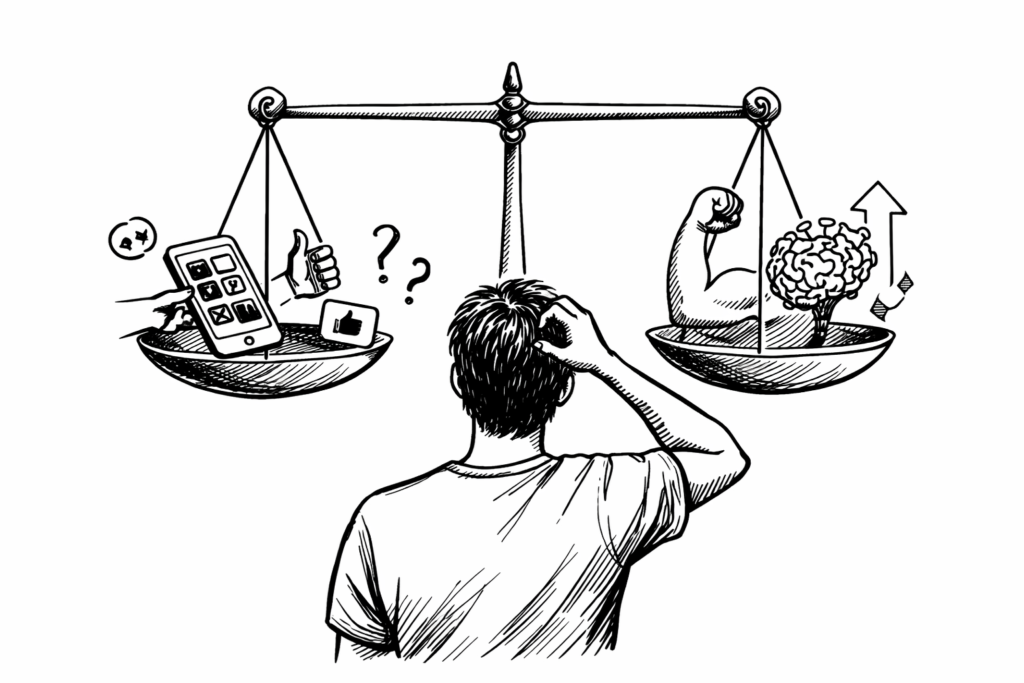
If we truly want to help users become stronger, UX research itself must change. Traditional usability testing focused on one goal above all. It aimed to eliminate points where users get stuck or slowed down. Negative obstacles were the enemy. But for tools of augmentation, some struggle that we might call “positive friction” is essential for growth.
Have the task encouraged users to push themselves?
Do users feel more capable after completing this task?
In UX research, we need to evaluate not just the convenience and comfort of the uses, but also feelings of competence and mastery. It is not enough to remove pain points. We also need to identify the power points, moments where users feel empowered. We believe these moments hold the key to UX research in the coming generations.
Closing
Which path will we choose?
Nietzsche once said that humans are like a tightrope stretched between beasts and the overman.
Will we stay where we are, or step across to the other side? With the powerful technology of AI in our hands, UX design is expanding beyond the design of interfaces. It is now reaching into the design of human evolution itself.
Products and services can make users weaker or stronger. The real question isn’t which one users choose, but how much room they leave for self-transformation. How does your product or service help users grow and change? Does it leave them as powerless “Last Man,” or does it spark creativity and guide them toward becoming “Overman”?
Maybe, the best UX isn’t about making things easier. Maybe it’s about making people greater.
UX research that goes beyond mere usability to explore the expansion of human capability is possible. Let’s continue to explore together, how that possibility takes shape in real experiences.
Related Articles:


UX can strengthen users not only through challenge, but also by letting them make choices that shape their experience and sense of agency.
AI raises questions about human agency not only in products, but also in UX research, where synthetic users help explore early ideas while real users reveal deeper experiences.