Article Summary
- Why Onboarding Fails: When onboarding explains too much too soon, it can overload users and weaken understanding instead of supporting it.
- A More Subtle Approach: Drawing on Rousseau’s idea of “negative education,” effective UX can guide users quietly through design cues rather than direct instruction.
- Trusting Users to Learn: Giving users room to explore helps build autonomy, competence, and deeper engagement than step-by-step guidance alone.
You open an app. The screen suddenly darkens, and the arrows guide you through a tour for the next steps. “Click here.” “Now try this.” Without even thinking, we start looking for the skip button, and we don’t remember anything from the tour.
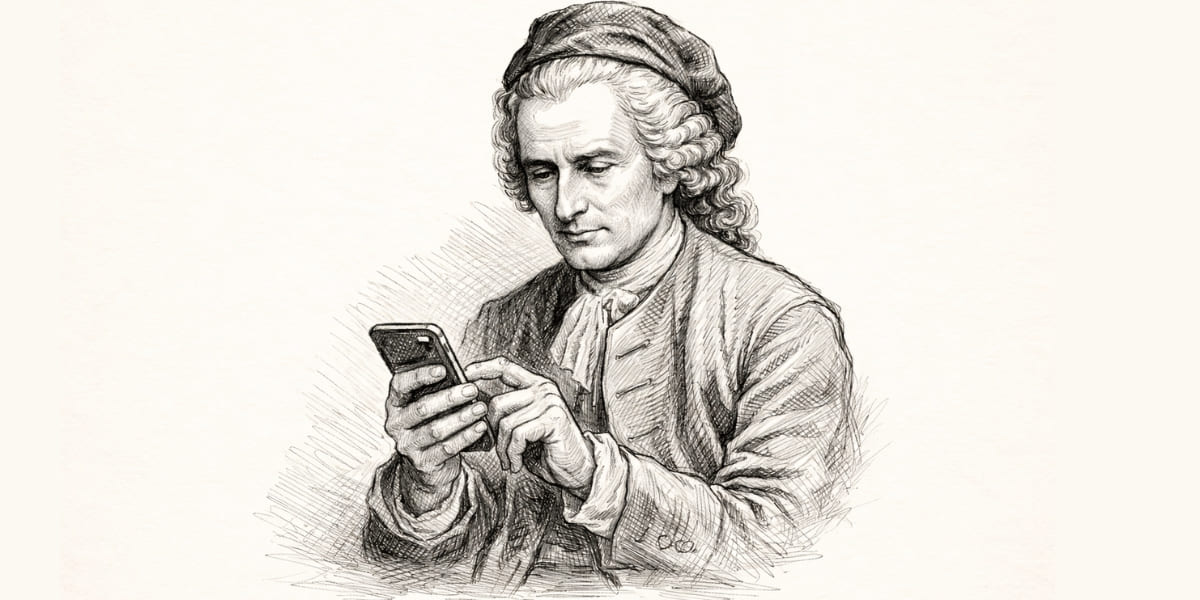
Why do carefully designed onboarding guides sometimes push users away instead of helping them? Surprisingly, a clue to this question can be found in “Émile”, a book written by the 18th-century philosopher Jean-Jacques Rousseau. In this article, we’ll use Rousseau’s idea of “Negative Education” as a tool to explore an alternative approach to onboarding, one that differs from the conventional “helpful” design and instead leads users toward true mastery.
The Paradox of Teaching: Why Explanations Can Backfire
Rousseau argued that teachers should not interfere too much in the learning process.
-2-e1775108564845-150x150.png)
“Do not give lessons in words. Give them through experience.”
-2-e1775108564845.png)
“Do not give lessons in words. Give them through experience.”
Most modern onboarding UX is designed to prevent users from getting lost.
But when taken too far, it can start to resemble the kind of cramming education Rousseau criticized. Flooding users with feature explanations that lack context risks having the information pass straight through without being retained.
This can be explained by cognitive load theory in learning psychology. Human working memory has a very limited capacity, and when users are presented with explanations that are unrelated to their immediate actions, the brain simply cannot process everything. Ironically, the more carefully we try to explain, the greater the risk that we end up hindering understanding rather than supporting it.
The Best UX Might Be “Negative”
So should designers do nothing at all? This is where Rousseau’s idea of negative education becomes useful.
“The first education ought to be purely negative. It consists not in teaching virtue or truth, but in preserving the heart from vice and the mind from error.”
“The first education ought to be purely negative. It consists not in teaching virtue or truth, but in preserving the heart from vice and the mind from error.”
Translated into UX terms, this means that design should not focus solely on actively teaching users the correct path. It also calls for a more hands-off approach, shaping the interface and the surrounding environment so users are unlikely to wander in the wrong direction. The designer stays quietly in the background. Instead of telling users what to click, they place cues that naturally draw users toward the right action.
Rousseau put it this way:
“Let the pupil always believe he is always master and let it always be you who are the master.”
“Let the pupil always believe he is always master and let it always be you who are the master.”
Users feel as though they discovered the solution on their own. In reality, that freedom is carefully designed, and is what makes the experience motivating.
Designing for Autonomy: A Self-Determination Theory Perspective
Why does a hands-off approach sometimes work better?
Self-Determination Theory, a foundational framework in motivation research, helps explain why. It suggests that intrinsic motivation depends on three basic psychological needs.
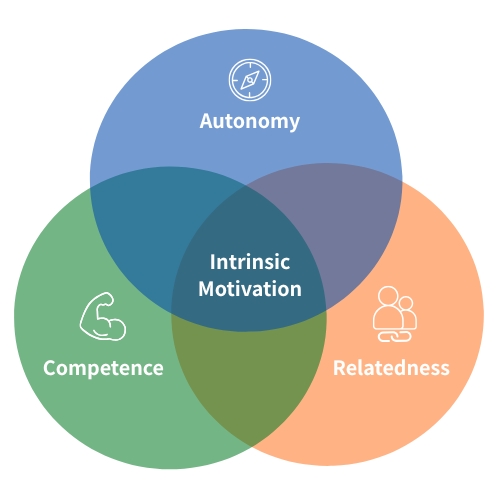
Autonomy: the feeling that you are acting by your own choice
Competence: the feeling that you are capable
Relatedness: the feeling of being connected to others
Tutorials that feel mandatory can undermine autonomy. The moment users feel they are being forced to do something, their motivation to learn can begin to fade. By contrast, a Rousseau inspired approach allows users to learn through trial and error. After experimenting, users reach that moment of realization. This is where the generation effect comes into play. Information discovered through one’s own effort tends to be remembered better than information that is explained by others.
More importantly, discovering something on your own builds a strong sense of competence. Feeling capable without being explicitly instructed helps users trust not only the product, but also their own ability to use it. Over time, this confidence becomes the foundation for deeper engagement.
Having the Courage to “Lose Time”
Much of today’s UX thinking focuses on shortening Time to Value, reducing how long it takes for users to experience value. This focus makes sense. But Rousseau looks at this problem from the opposite direction.
“The most important and useful rule of all education is not to gain time, but to lose it.”
“The most important and useful rule of all education is not to gain time, but to lose it.”
Giving users shortcuts and optimal paths from the very beginning is not always the right answer. There is value in deliberately allowing time for trial and error, in letting users “lose time.” By touching the product, making mistakes, and trying again, users begin to develop a feel for the tool and build a mental model of how it works. Knowledge handed over too quickly is fragile. Experience built slowly over time leads to understanding that lasts.
From “Students” to “Natural Humans”: Designing with Trust
“It won’t work unless we explain everything.” That concern is understandable. But it may also reflect the creator’s lack of trust in users’ intelligence and ability. Rousseau believed in the innate capacity of children to learn on their own. Perhaps we can place a little more trust in our users as well.
Does your product treat users like students who can’t move without step-by-step instructions? Or does it leave space for users to walk on their own, discover, and grow, like the natural learner (Émile) in Rousseau’s work? “To teach by not teaching.” Embracing Rousseau’s paradox may be one of the best ways to design UX that helps people experience complex, AI era tools as extensions of their own hands.
If we want to design UX that truly trusts users, one place to begin is by reexamining your current onboarding and education approach through UX research and viewing it from a slightly different angle. At Uism, our goal is not to only provide answers, but to work alongside you as a partner in cultivating better questions together. If you are interested in designing UX that places trust in users, we are here to talk.
References:
- Jean-Jacques Rousseau, Émile (various editions, incl. Iwanami Bunko)
- Deci, E. L., & Ryan, R. M. (1985). Intrinsic Motivation and Self-Determination in Human Behavior.
UX Research & Strategy
Learn more about Uism’s UX research services.