

✶Article Summary
- •The Japanese philosophy of Sanpo-yoshi illustrates the value of mutual trust and explains the boom of the influencer economy in digital communities.
- •Prioritizing community (seken-yoshi) strengthens business trust, driving sustainable growth in online markets.
- •Businesses should leverage authentic influencers or connect directly with audiences to build meaningful ties.
I, like many others, spend a lot of time online. Whether it’s scrolling through photos and stories on Instagram or enjoying livestreams and videos on YouTube, I spend a significant portion of my free time consuming new content, learning new things, and purchasing new products from my favorite creators. For that last point, I would say I have viewed and bought more items that were directly recommended by an influencer I follow than any product pushed directly on me via some algorithm. This is not a unique case; in a recent qualitative study (n=13) we conducted last year looking at online shopping trends, Japanese participants of all ages preferred to buy products that had been recommended to them by a creator they follow on social media, with the Gen Z participants especially favoring it. The logic behind the “influencer boom” is neither recent nor complicated. In fact, it can be explained very succinctly by a Japanese philosophy used more than 150 years ago, a philosophy that, in the smaller, online world, is more important than ever for businesses to leverage in order to ensure their long-term success.
Sanpo-yoshi: An Introduction
三方良し, read as sanpo-yoshi and translated literally as “the good for 3 sides,” is a business practice and philosophy primarily attributed to the merchants of Omi. These merchants resided and operated out of central Japan in modern-day Shiga prefecture, reaching their heyday during the Edo period. As the name would suggest, sanpo-yoshi’s “good” refers to the benefit and prosperity of 3 distinct parties:
売り手良し (urite-yoshi)
The good of the seller
買い手良し (kaite-yoshi)
The good of the buyer
世間良し (seken-yoshi)
The good of the community/society
The first is self-explanatory, if the seller cannot make a living in their trade, they cannot sustain their services for the individual buyer or community at large. The second point is well within the realm of traditional UX/UD, providing a product or service that meets the needs of the buyer at a price they are willing and able to purchase. It is the third part that was considered a unique practice for the time. By giving back to the community through the patronage of art, donations to local temples, or even development of infrastructure like bridges and roads, the Merchants of Omi directly attributed to the wellbeing and prosperity of the areas they conducted business while generating recognition and positive influence for themselves. In essence, these traveling salesmen operated as an active member within every community they visited, and their products and influence spread all across Japan. Several modern corporations such as Takashimaya (department retail), Itochu (trading and investments), and the Seibu & Saison Group (railways and real estate) directly trace their founding to Omi with several other businesses adopting the philosophy for their own purposes.
These 3 ethics read similar to modern design principles. Urite-yoshi equates to designing a sustainable business while kaite-yoshi is the measurable goals of improving user satisfaction. The third, seken-yoshi is the area often put aside or deprioritized in digital spaces, but where the greatest potential for additional value lies.
The Evolution of Sanpo-yoshi
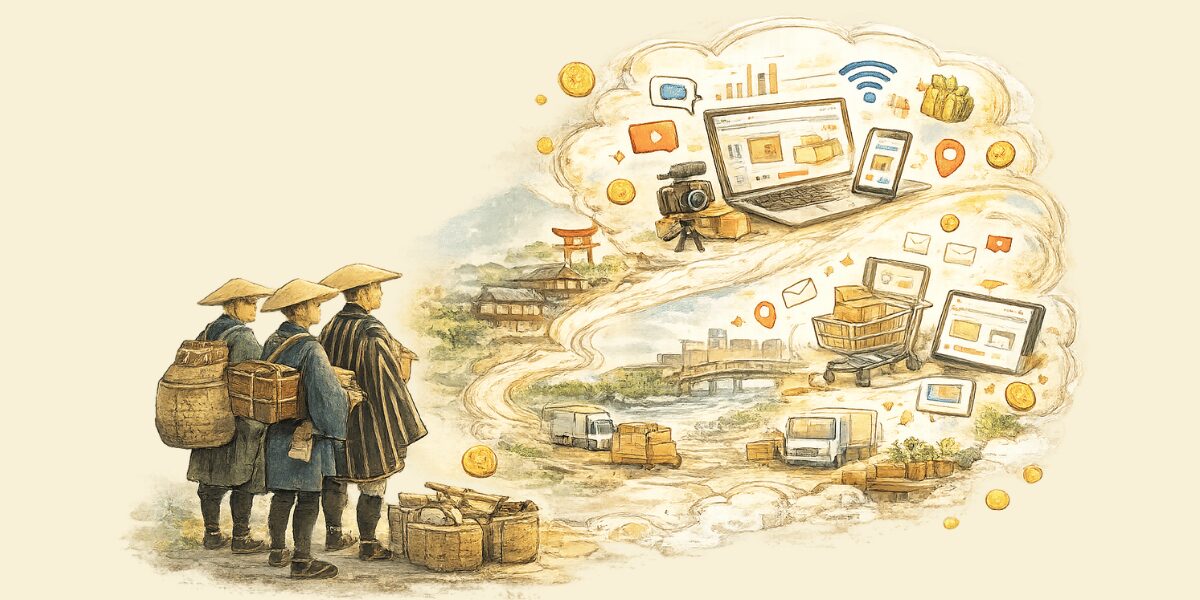
The door-to-door salesman is long dead; replaced by a new kind of merchant. With the ubiquity of social media, influencers can reach in a few minutes an audience that would take Omi traders days, or weeks, to contact. While the methods have changed, the philosophy behind the methods has endured.
Online icons and micro-celebrities still need to make a living. Whether as a full-time online content creator or as an amateur hobbyist, influencers will congregate where there is an audience to reach and money to be made. For Japan, YouTube, Instagram, and TikTok stand as the pillars of content platforms. All succeed by providing a low barrier to entry with a high possible ceiling of viewership within any potential genre of content, no matter how niche. These social networks are the plazas of online bazaars, abuzz with people from all walks of life selling their craft, and evolving their brand into an established name to be subscribed to or followed.
The agency allowed the modern buyer cannot be understated in the success of social networks as marketplaces. While townsfolk were at the whims of the local products available to them, audiences on social media are curators, able to choose when to consume which content and how much to consume. More power than ever has been granted to an online consumer to tune in, or tune out, the advertising and product-pushing surrounding them.
Furthermore, the mechanisms available to communicate and interact with the selling influencer have improved. Through the public display of views, likes, and comments, the viewer’s standing has improved to be on more even footing with more open lines of communication to the influencer, compared to the classic connection between consumer and corporation. This empowered consumption allows viewers who purchase through social media to purchase with confidence; i.e. trust in the creator to recommend them a product or service suitable to them, and trust that their voice will be heard should the it prove to be false advertising.
Advancements in digital technology have revolutionized the definition of community and sense of belonging. It is here that the core message of sanpo-yoshi shows its merit, with both influencer and viewer alike operating as an integral part of an online community. An influencer is not considered to be only a salesman, but an entertainer, expert, or even a friend. The products they recommend do not come from the position of a business, but as a person who plays a vital role in the viewer’s lifestyle.
Furthermore, the influencer relies on the health of their community to operate. They are directly invested in seeing their viewers succeed, and thus greatly rely on mutual trust and connection. Moreover, our research in both e-commerce and traditional shopping has concluded on multiple occasions that Japanese customers require high confidence in the product or service before proceeding to purchase. That confidence is instilled through clarity of information, absence of social risk, and social endorsement. Reassurance that a product or service is right to buy often comes online via the good word and expertise of trusted online creators or a few good words by previous buyers in review sections. While the final decision is up to the individual, they often borrow the power of the community to draw their conclusions quickly and expedite their shopping journey, and Japanese shoppers often won’t take action until that level of confidence is met. It is thus in the best interests of businesses to ensure a smooth, self-reinforcing trust within an online community to promote confidence in first purchase, and repeat purchases. When the community comes first, long-standing business follows. For a more specific example and detailed breakdown, take a look at our article below.
Related Article
See how Japan’s Gen Z uses social media to discover products, build trust, and make purchase decisions, revealing why online communities have become essential to modern consumer behavior.
How Sponsors can Adapt
It is important then for a business with any online presence to take into account their relation with their target audience and the communities they claim membership to. From the position of 後援者(kouensha) or “sponsor,” a business has two major strategies available for best leveraging the online ecosystems.
Find representative influencers
One method is to utilize pre-established influencers in traditional sponsorship. In this case, the influencer performs similarly to a buyer in connection to the sponsoring business. Some things to consider when choosing influencers to work with:
-6.png)
- Confirm the influencer’s audience overlaps with your business’ target audience.
- Check the frequency and quality of engagement they have with their audience.
- Ensure there is a brand fit. Would the influencer be interested in the product or service if no sponsorship was involved? Would the business want them to recommend the product unprompted?
Take on the role of influencer
Another method is to take out the middleman and put effort into direct connection with a business’ target audience online. A direct and interactive line with an online followership means the corporation operates similarly to an influencer with the main objective being to advertise and sell products or services. Some things to consider when creating a more direct and interactive online presence:
-7.png)
- Engage like a person, not a corporation.
- Utilize the platform and media type that best showcases your brand and products.
- Have a story that resonates with the target.
- Make your social presence known and easily discoverable. Loyal customers will most likely start their journey from a product and e-commerce side, not a social media side.
If a one-time transaction is the goal, a business is fine to operate with their own interests in mind and disregard their effect on the seller or shared community. But to build rapport and loyalty in a customer, a long-term strategy built on a mutually shared loop of feedback and experience between buyer and seller is fundamental. Whether joining an established community or building a following from scratch, this is the foundation of sustainable growth and success. We touch on and offer some valuable advice for how to best utilize metrics gained from this shared experience below.
Related Article
Explore why great UX is built through connected experiences shaped by small interactions over time.
Conclusion
The interconnectedness and communal cultivation capable through social media has enabled tightly-knit clusters of social circles to form. These circles operate on an established social contract between the influencing force and their viewers. Businesses that effectively harness the good of these circles through an emphasis on integration and adding value to a community will build brand loyalty and trust in their audience to not only support a business, but support a friend.
As UX researchers, we at Uism are finely attuned to the needs and values of all three sides of the sanpo-yoshi philosophy. For businesses seeking counsel on how to reach and understand their target buyers, as well as recognize the contextual background of communities such buyers belong to and identify with, please feel free to reach out to us for assistance.
UX Research & Strategy
Learn more about Uism’s UX research services.