


Article Summary
- PMDA submissions: Don’t treat usability (62366-1) and risk management (14971) as separate tasks.
- Integrated framework: Treat the usability standard (62366-1) as a subprocess within the main risk framework (14971).
- Practical workflow: Translate abstract risks from 14971 into concrete, testable use scenarios for 62366-1 validation.
As you prepare your submission to Japan’s Pharmaceuticals and Medical Devices Agency (PMDA) and set your sights on the Japanese market, you may already be running into questions around usability evaluation requirements. These are questions we hear frequently from international teams:
- “What’s the real relationship between the usability standard (JIS T 62366-1) and the risk management standard (JIS T 14971)?”
- “How are we supposed to integrate our usability engineering process with our risk management activities?”
These are questions we frequently hear from international manufacturers and service providers.
Since April 2024, compliance with JIS T 62366-1:2022 (or its international equivalent, IEC 62366-1) has become a mandatory requirement in Japan. This means these questions are no longer just about understanding the theory; they’re about a critical factor that can determine the success of your submission. For PMDA, safety is not just about preventing device malfunction. It requires that risks arising from use error—mistakes made by the user—are also identified and properly managed.
In practice, usability and risk management cannot be treated as separate activities. They must be designed and executed as a single, integrated system.
In this article, we’ll break down the two core standards and related documents central to PMDA submissions and explain how to put them into practice as an integrated risk management model.
Why You Need to Understand Both Standards at Once
In the context of PMDA submissions, usability engineering is considered a part of your overall risk management activities.
As of April 1, 2024, medical devices sold in Japan must, in principle, comply with JIS T 62366-1:2022 (Usability Engineering). This is now a practical necessity. And this standard cannot be applied in isolation from the medical device risk management standard, JIS T 14971:2020.
The PMDA defines “safety” as having objective evidence that a device can be used safely, with all unacceptable risks eliminated or reduced. The key here is that “risk” isn’t limited to technical failures. Use errors, such as misinterpreting information or making a slip, are treated as equally critical risks that must be managed. In other words, even a device with brilliant functionality can be deemed “unsafe” if its interface is so complex that it invites errors.
This is where the two standards work together to systematically address use-related risks: JIS T 14971 covers all reasonably foreseeable misuse, including “abnormal use,” while JIS T 62366-1 specifically hones in on use errors that can occur during “normal use.”
JIS T 14971
Defines the overall framework for risk management.
JIS T 62366-1
Provides the specialized process for handling the human-related risks within that framework.
This means you don’t run two separate processes. This requires an integrated risk management perspective that operates with a single, consistent logic.
The Two Main Standards: Risk Management and Usability
First, let’s get a clear understanding of the roles of the two core JIS standards for your PMDA submission.
1. JIS T 14971:2020 – The Foundation of Risk Management
Based on ISO 14971, this standard establishes a systematic process for managing risks throughout the entire lifecycle of a medical device. It serves as the overarching framework for all safety-related activities, including usability. Here are three key takeaways:
Ⅰ.The Overall Risk Management Framework
It defines the end-to-end process: identifying hazards (potential sources of harm), estimating and evaluating the associated risks, implementing risk controls, and verifying their effectiveness—from product concept to disposal.
Ⅱ. Identification of Reasonably Foreseeable Misuse
The standard requires a comprehensive analysis of potential misuse. This includes not only unintentional use errors but also intentional “abnormal use,” like a user ignoring a warning in the instructions for use. This analysis becomes the starting point for your usability engineering efforts.
Ⅲ. Clarifying the Causal Chain: Hazard, Hazardous Situation, and Harm
This is the process of logically linking cause and effect to answer, “Why does this action lead to harm?” For example, you would map out a chain like:
Small text on a display (Hazard) → User misreads the setting value (Hazardous Situation occurs) → Medication is overdosed (Harm).
Clarifying this chain helps you target your risk control measures effectively.
2. JIS T 62366-1:2022 – Usability Engineering for Human-Related Risks
This standard, which is technically identical to IEC 62366-1:2015+AMD1:2020*, is a specialized process focused on mitigating risks arising from normal use (errors made while trying to use the device correctly), which were identified within the broader scope of JIS T 14971. In other words, within the overall safety framework set by risk management, usability engineering provides specific methods for analyzing and evaluating the particular domain of human-related risks. Its key components include:
Ⅰ. The Usability Engineering Process (Clause 5)
This systematic process consists of nine main steps, starting from “Preparing the Use Specification” to “Identifying Hazard-Related Use Scenarios,” and running through “Formative Evaluation” and “Summative Evaluation.” Adherence to this process itself serves as objective evidence for the PMDA.
Ⅱ. Design Improvement through Formative Evaluation
This is an iterative process conducted repeatedly during design and development. By having real users test prototypes, you can identify issues early and refine the design. It’s a crucial step for improving the quality of your user interface.
Ⅲ. Safety Verification through Summative Evaluation
This serves as the final validation step. Using the final user interface, you evaluate the hazard-related use scenarios to obtain objective evidence that the usability for safety is adequate. For a PMDA submission, this evaluation is the core evidence demonstrating that your risk control measures have been effective.
*The PMDA accepts compliance with internationally recognized standards like IEC 62366-1:2015+AMD1:2020, as long as you can logically explain how it meets Japan’s essential requirements.
Related Article
For an overview of PMDA usability requirements, see this related article. It explains key points for international manufacturers, including PMDA expectations, use of overseas data, and evaluation design rationale.
The Interplay between the Two Standards: An Integrated Risk Management Model
The practical question, then, is how these two standards are integrated. The practical key is to treat 14971 as the master framework and embed 62366-1 as a subprocess within it.
Usability activities don’t exist in a vacuum. They are an integral part of the risk management process, linking closely with the “Risk Analysis” and “Risk Control” phases.
The specific point where they connect is the “Hazard-Related Use Scenario.”
Step 1 14971
- Conduct a risk analysis to identify “hazardous situations” that could lead to harm.
- Example: For an infusion pump, identify the hazardous situation “over-infusion of medication.”
Step 2 62366-1
- Analyze and define the specific sequence of user actions (scenario) that could lead to that hazardous situation.
- Example: Create a scenario: “On the dose setting screen, the user overlooks the unit (mg/mL) and inputs a value 10 times what was intended.”
Step 3 62366-1
- Test this scenario in a summative evaluation to gather objective evidence that the user interface can be used safely.
Step 4 14971
- Feed the results back into the overall residual risk assessment to make a final judgment on the device’s safety.
This flow—translating abstract risks into concrete use scenarios and validating them through evaluation—is the core of integrated risk management.
Supporting “Related Standards and Guidelines”
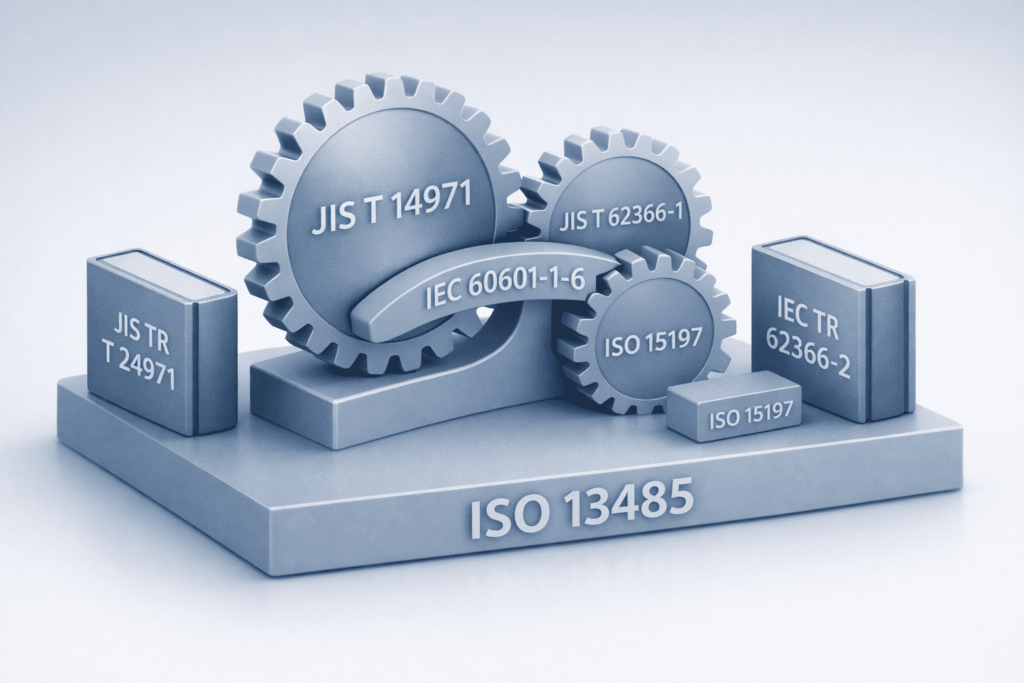
These two main standards alone might not always give you the “how-to” for every situation. In practice, you can get a clearer picture by referring to the following related documents:
IEC 60601-1-6 (Collateral Standard for Usability of Medical Electrical Equipment)
For medical electrical (ME) equipment, this standard acts as a bridge between the basic safety standard (JIS T 0601-1) and the usability standard (JIS T 62366-1). Be aware: simply following the 62366-1 process isn’t enough to meet this collateral standard’s unique requirements for the instructions for use, so you must review it as well.
IEC TR 62366-2 (Guidance on the Application of Usability Engineering)
While JIS T 62366-1 focuses on safety, this technical report (TR) is a practical textbook that covers broader usability topics like efficiency and satisfaction, along with detailed evaluation methods.
JIS TR T 24971 (Guidance on the Application of Risk Management)
This guidance document provides detailed, practical methods for implementing JIS T 14971 in the field. Its in-depth explanations of use error analysis and risk estimation are especially helpful for improving the quality of your risk analysis.
Particular Product Standards (e.g., ISO 15197 for Blood-Glucose Monitoring Systems)
For certain product categories like blood-glucose meters, particular standards may contain their own unique usability requirements. It is essential to check for any particular standards relevant to your device.
ISO 13485 (Quality Management Systems for Medical Devices)
This is the international standard for a Quality Management System (QMS) specific to medical devices. It specifies the organizational structure and processes needed to ensure a product is consistently safe and meets regulatory requirements. The usability and risk management activities we’ve discussed are not one-off tasks. The resulting Usability Engineering File (UEF) must be formally integrated into your QMS as part of the design and development process, subject to design reviews and change control.
A Special Case: Handling Existing Products (UOUP)
A common challenge many manufacturers face is, “What do we do with products that were fully developed and commercialized before the major PMDA changes in April 2024?”
An existing user interface that lacks development records compliant with the latest JIS standards is defined as a UOUP (User Interface of Unknown Provenance). For these, an alternative process outlined in Annex C of the standard is permitted.
Instead of retroactively applying the full usability engineering process (Clause 5), you can demonstrate that the usability meets safety requirements by reviewing post-market data (complaints, adverse event reports), comparing it to equivalent devices, and conducting expert reviews (e.g., heuristic evaluations).
However, if you make any modifications to a UOUP (e.g., design tweaks, feature additions), the modified parts and any affected areas must follow the standard usability engineering process. Furthermore, if a UI change is needed for risk control, the modified portion cannot be treated as UOUP. This isn’t a simple workaround, so careful planning is required.
Conclusion: A Cohesive Logic and Usability Strategy for Successful PMDA Submissions
PMDA does not evaluate only the final product—it evaluates the logic behind how safety has been ensured. They’re looking for a cohesive logic throughout your development process, backed by objective evidence.
The key to success is to properly reference the family of standards centered around JIS T 62366-1 and JIS T 14971, execute all activities in accordance with your QMS, and document the entire process in your Usability Engineering File.
At the same time, we see many companies run into practical challenges, such as:
- Identifying the right use scenarios to evaluate.
- Reflecting Japan-specific medical environments and user characteristics.
- Ensuring documentation quality that meets PMDA standards.
These are issues that can’t be solved by simply reading the standards; they require experience-based design and planning.
As specialists in medical device usability evaluation in Japan, we can support you every step of the way—from planning and execution to documentation. We help you not only comply with regulations but also create a product that is truly safe and easy to use for Japanese users.
If you are preparing for a PMDA submission or planning usability validation in Japan, feel free to reach out to discuss your project.
Human Factors Research
Learn more about Uism’s UX research services.
References
- JIS T 62366-1: 2022(Medical devices – Part 1: Application of usability engineering to medical devices)
- JIS T 14971: 2020(Medical devices-Application of risk management to medical devices)
- PMDA Usability of Medical Devices