
Article Summary
- The author explains their own mindset and observations for the visit and design of a bar for deaf people.
- Intentional design choices and staff training reveal the bar’s successful implementation of first user inclusive design practices.
- Assistive tools are not one-size-fits-all, and have drawbacks and use cases that can be revealed from testing and observation of usage.
- Accessible services are built not only on tools, but on staff behavior, training, and continuous improvement based on the perspectives from first users.
Ever since coming to Japan I have been enamored by its bar scene. There’s a certain kind of bar, known as a スナック or “snack” that gives a tight, “at home” feel. Frequent it enough, and everybody knows your name. Recently though, I had caught wind of a bar for people with auditory disabilities and, seeking better immersion and understanding of their experiences, I exercised the curious nature common at Uism and set out to Ueno in the eastern part of Tokyo to investigate and learn more. Let me tell you a little about the sign language Bar SELF.
Preparations to Enter an Unfamiliar Community
It would have been reckless and impertinent of me to enter into a space where I, as someone lacking any hearing disability, would be an outsider–at least without any proper invitation or warning. Bar SELF has regular times in a week for sign-only customers. I confirmed the schedule they had shared on social media and even after receiving the ok to come, assumed I would encounter some people with auditory disabilities and ran a mental checklist to ensure I would not offend anyone and embarrass myself or my company.
My Mental Checklist
They’re just people having a drink.
There is no need to ask them about their condition more than is necessary to communicate. Assuming you have made proper accommodations to communicate with them as you would anyone else at a bar, and are aware of the proper terminology to use and any phrases to avoid, there is nothing “extra” in your care that needs to be done.
Prepare a transcribing app to use as necessary.
The one I chose, UD Talk, was free, easy to use, and accurate, even at normal speaking speed. Additionally, lip reading is possible by some people with hearing disabilities, and will supplement the transcriptions, so consciously avoid covering your mouth or otherwise warping your lip’s readability, such as talking while eating or drinking.
Be as transparent as possible.
If asked why you’re there, let them know about your interest and your profession so they know where you are coming from. There’s no reason to hide intentions, especially with minority communities that may be more wary of ill will.
Be willing to learn!
The earnestness of your efforts will make up for any errors in your actions. If you are critiqued, accept it graciously and make a mental note so it doesn’t occur again.
This checklist was rooted in my knowledge and study of accessibility and disability as well as Uism’s moderation practices we use to help a subject feel at ease and be more willing to cooperate and share their thoughts in a study. Like any standard ethnographic study, the aim is to be respectable and accommodating so that the other party feels comfortable and like I am not intruding. With these 4 points in mind, I hopped on the train to Ueno to see the bar and conduct my observation.
First-hand Experience at the Bar
At first glance, to my slight surprise, the bar didn’t seem much different from any I would usually go to. The day I happened to visit the bar was not a sign-only day, so the three bartenders on shift were three bartenders who 1. Lacked any hearing disability, and 2. Did not actually know sign language. By most accounts, the bar looked just like any other bar, but I did notice a few points that would be more accommodating to patrons who were hard of hearing or deaf.
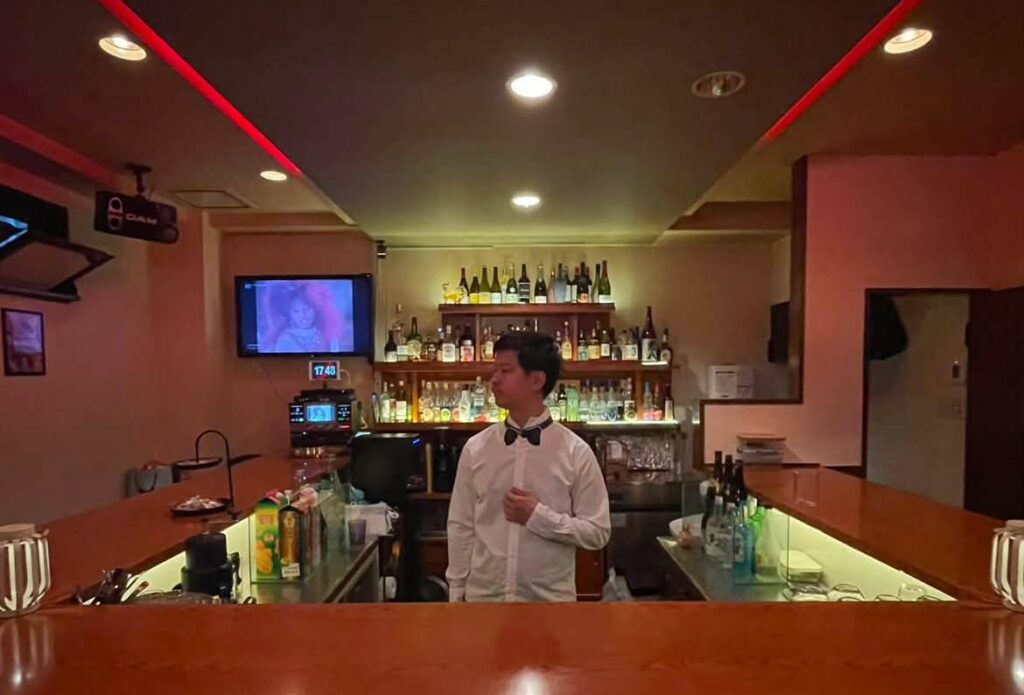
First, the bar was very well lit with the bar set up in a U shape that allowed all three staff to manage one side. Visibility is important to people who are hard of hearing, both for understanding, and for quality service. Some people have speech disabilities coupled with their auditory ones, meaning they may not be able to easily voice their need for attention. Brighter lights, and more staff on hand, allow for an equitable level of customer service.
Additionally, I noticed the layout of the menu and liquor selection was visual-heavy. Pictures were included beside bottle descriptions and all alcohol was displayed clearly with nothing being obscured. While simple, visual clarity enhances the serviceability and overall customer experience.
Most unique though, were a set of whiteboards and erasable markers hanging on one side. At first I was intrigued by these analog tools for communication, but thinking deeper, there are several advantages boards have over typing into a phone and showing text.
- Primarily is the size advantage. Most of the customers, and one of the staff, were older. A few wore glasses or put them on any time they looked at their phone. For a subset who have both hearing and vision disabilities, a level of visual clarity beyond that of a smartphone is required.
- Furthermore, a smartphone is a private device—some customers or staff may be reluctant to show or exchange messages on a device with personal information.
- Lastly, a whiteboard can ironically be a faster means of communication. I watched a customer and a bartender use a board and, while one wrote, the other read along in real time and prepared an immediate response.
Beyond individual accessibility, the whiteboards operate as shared communication surfaces in the physical space—visible to others, enabling collaborative interaction, reducing isolation, and creating a communal context for conversation. This creates a functional equivalence near parity to a conversation occurring in any other bar. I ultimately believe the bar succeeds in designing a space that is not only barrier-free, but hospitable for their key audiences.
The key to a successful snack bar in Japan lies in its staff. Bartenders are expected to converse and even drink with customers, and accessibility here depends as much on behavior and training as on tools. I observed a rookie bartender demonstrate this when two customers arrived—one with a hearing aid who would speak while simultaneously signing his words to his deaf, non‑verbal partner. The bartender did the right thing by not talking to the severely deaf patron through the one who could speak. Instead, he would look at and address the non-verbal patron directly, with interpretation as necessary, and utilized the whiteboards between the three for a delightful and deliberately inclusive interaction for all. This scene illustrates that accessible service is not solved just by the presence of assistive devices, but requires operational learning, training, and the routine use of supportive strategies by involved staff.
Assistive Tool in Theory vs. Practice
Using the tool I had prepared in advance, I decided to strike up a conversation with the pair of patrons.
In Theory:
UD Talk is an automatic speech-to-text and translation app that has excellent accuracy and voice capture ability. I have used it before for interpretation in live-meetings before where it’s important to follow multiple people’s comments.
In Practice:
That strength becomes a weakness in a bar setting, though. I would speak, and the app would transcribe well, but it would also transcribe the conversations of everyone else in the bar TOO well. This left the severely deaf fellow-patron I was trying to converse with unable to keep up, as the app quickly flooded with records of each and every interaction.
Furthermore, the text size was too small for the middle-aged man to see well, and I wasn’t familiar enough with the settings to adjust the app to be more suitable for the setting.
In the end, we defaulted to the strategies already provided by the bar, and had an enjoyable chat about my work and hometown via whiteboard. This instance and emerged pain point shows the importance of designing and testing assistive technology with first users in real-case situations. While the app is without a doubt a useful tool for communication, a situation like this shows its drawbacks in the lived user experience and the necessity for additional accommodations.
Final Words: The Power of Place
I had a moment to talk with the bartenders about the mission and early days of Bar SELF. From them, I learned how the bar was initially created by a man whose partner is deaf. Word spread quickly through the deaf community and the bar has become a major hit because of it, not only within the community, but with those seeking to learn more about the deaf community (they even have beginner’s sign language lessons). In the bartender’s words:
There isn’t really a place like this for deaf people, so they come from all over.”
That remark denotes the ability of the barmaster to accurately hit on a clear need within a sizeable market, and the scarcity of bars in a city as large as Tokyo capable of accommodating such a community. Moreover, it further illustrates the value of first users in the design and development of products and services, specifically in accessible, inclusive design.
Bar SELF is not strictly a “deaf bar.” In fact, most of the strategies and design decisions in place are not difficult for other bars to implement. But by doing so with purpose, it has become a bar that specializes in accommodating and providing excellent service to a core demographic. From first user feedback early in its design and inclusive iteration, it can attend to the needs of a wider community. By setting people with disabilities at an equal level of importance in a product or service’s design, such designs succeed in appealing to a wider market.
UX Research & Strategy
Learn more about Uism’s UX research services.