
POINT 02
Allowing Users to Progress at Their Own Pace
This article uses Japan’s resurgent sticker trading craze and the revival of Heisei era retro games as a lens to unpack the psychology behind them, translating it into insights you can apply to product design. It’s written for teams and researchers abroad working on UX and product design for the Japanese market. Simply imitating the visual aspects—such as “cute,” “retro,” and “collectible”—doesn’t reveal why these trends resonate with today’s Japanese users. The meaning behind the behavior must first be deciphered.
Article Summary
- In Japan, sticker trading and new releases of Heisei-era retro games have grown into a social phenomenon, but these aren’t simply faithful recreations of the past—but reinterpretations with today’s cultural context.
- Behind this lies a psychological need to escape the fatigue of being constantly judged on social media, and to find comfort in experiences that can be enjoyed at their own pace.
- In product design, key insights include combining familiarity with novelty, creating low-pressure designs, and leaving room for each generation to interpret the product’s meaning in its own way. When entering the Japanese market, it’s more important to understand the meaning behind people’s actions than simple imitation.
日本で今、平成レトロに何が起きているのか
Sticker Trading Tops the Spring 2026 Trend Rankings
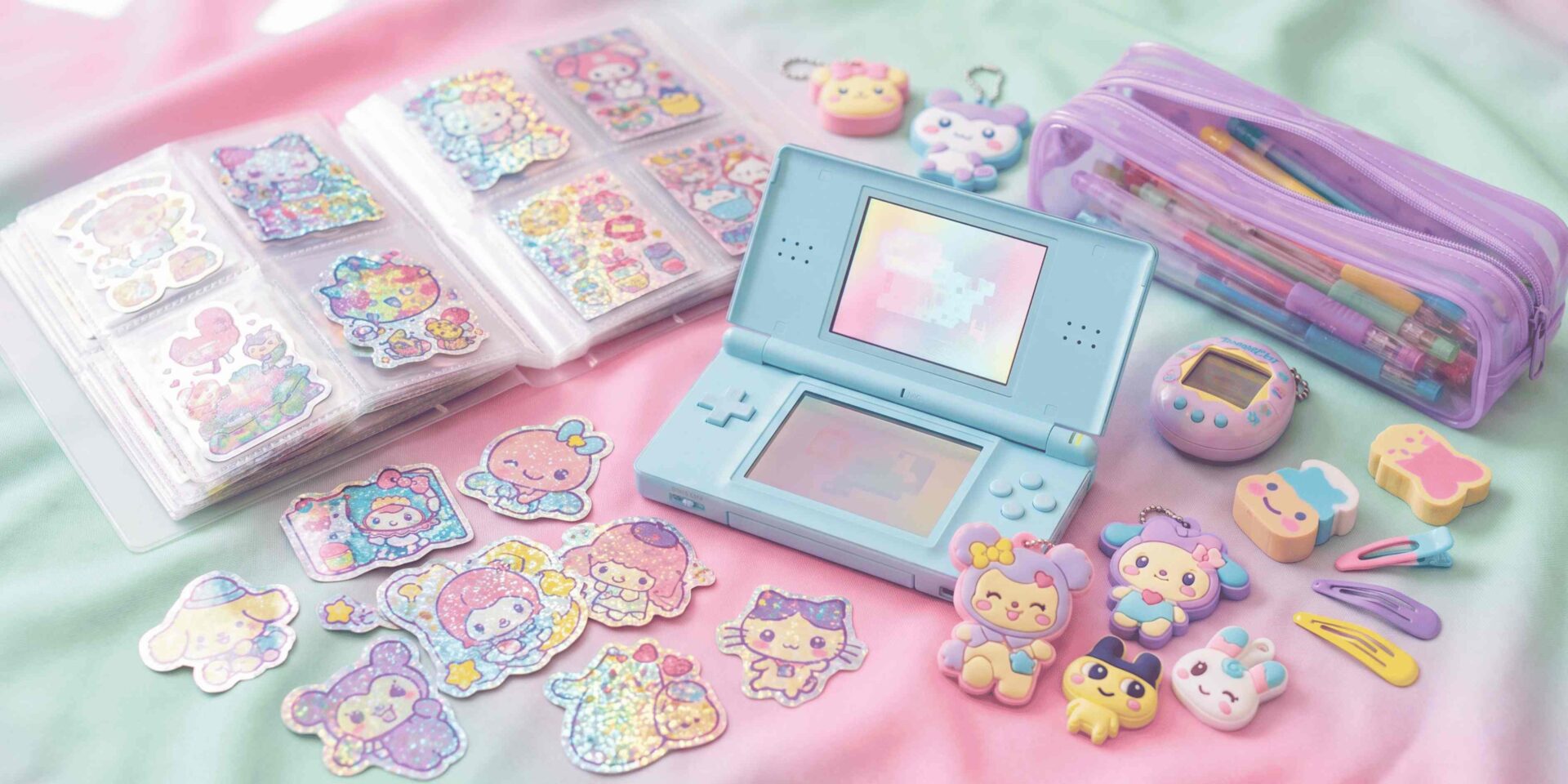
Sticker trading, once a quiet pastime Heisei era (1989-2019) elementary schoolers kept tucked in the backs of their notebooks, has become a full blown social phenomenon in Reiwa era (2019-present) Japan, spilling into classrooms, cafés, and social media timelines. In a spring 2026 trend survey, “sticker trading” ranked first (Source: CREATORS POST, 2026). Inpam, a company that designs and manufactures novelty stickers, saw order volume from January to July 2026 rise roughly 2.5x compared to the same period in 2024, driven largely by the so called “Heisei Joshi” (Heisei Girls) generation (women now in their 20s and 30s who spent their girlhood during the Heisei era) (Source: Inpam Co., Ltd., 2026). Popular stickers keep selling out, and that very scarcity seems to be fueling even more demand.
Retro Games Going Viral on TikTok
Something similar is happening in gaming. Tomodachi Collection (known overseas as Tomodachi Life) has been revived as a new title for Nintendo Switch, and a sequel to Rhythm Heaven has been announced for the first time in 11 years. These announcements have sparked a fresh wave of TikTok videos featuring gameplay footage from the original Nintendo DS versions (Source: Tokyo Cheapo、2026年). New releases are pulling old titles back into the conversation along with them.
Putting these two phenomena side by side:
| Phenomenon | Core Audience | Notable Numbers / Momentum |
|---|---|---|
| Sticker trading | Women in their 20s–30s (“Heisei Joshi” generation) | Orders up roughly 2.5x vs. 2024 (Source: Inpam, 2026) |
| Heisei retro game revivals | All generations (Gen Z to Millennials) | Original DS gameplay footage going viral on TikTok again (Source: Tokyo Cheapo, 2026) |
The generations driving each trend, and how far they’ve spread, differ — but both share one thing in common: something people once loved is being rediscovered and re-valued.
This pull toward analog experiences isn’t limited to the current boom. It’s a pattern that has shown up among Japan’s Gen Z before.
“Nostalgia” Alone isn’t the Answer
If you simply assume that these games are selling “because people are nostalgic for the past,” you’ll misunderstand the reality.
Both Tomodachi Collection and Rhythm Heaven are being released as new titles, not as remakes of past games. And these new releases are even reigniting interest in the original titles. Similarly, with stickers, the ways people enjoy them are expanding beyond simple collection to include trading and showing them off (Source: Impam Co., Ltd., 2026). It appears that nostalgic themes are being used as new forms of play within today’s social media and interpersonal relationships.
In a previous article, we also highlighted how Japan’s Generation Z enjoys analog experiences not only for their nostalgic value but also as “new discoveries.” For a generation that didn’t experience these things firsthand, it may feel akin to exploring an unknown world.
Related Article
Explores why Japan’s digitally native Gen Z is drawn to analog experiences like vinyl records, film cameras, retro cafés, and capsule toys, covering digital fatigue, the “emoi” feeling, and how they fluidly switch between analog and digital.
Why Are Millennials and Gen Z Drawn to Nostalgia Right Now?
The question still remains; why now? One possible hypothesis is so-called “evaluation fatigue.”
The question still remains; why now? One possible hypothesis is so-called “evaluation fatigue.”
Posting on social media is interactive to some extent. Whether it’s the photos you post, the words you choose, or the clothes you wear, there’s a possibility they’ll be seen, compared, and judged by others.
In fact, in a survey our company previously conducted targeting Gen Z, several participants mentioned feeling exhausted by the very act of posting on social media and the reactions it elicits. It seems that the constant feeling of being watched and compared is unconsciously building up as a burden. Activities like collecting stickers or playing retro Heisei-era games—which can be enjoyed at one’s own pace without needing anyone’s approval—may hold a particular appeal precisely because they offer a respite from this fatigue. Of course, this is merely a hypothesis derived from the scope of our survey and does not apply to everyone. However, when designing products for Gen Z, it’s a perspective that is hard to ignore.
Perspectives to Apply to Product Design
This phenomenon offers three insights that can be applied to product design:
POINT 01
Combining Familiarity and Novelty
In surveys targeting Gen Z that Uism has conducted to date—focusing on games and character-based content—it was not uncommon to hear of deep-rooted support for “things they know” and “things they can enjoy with peace of mind,” more so than even enthusiasm for new content.
On the other hand, just as new “Heisei retro” titles are bringing old classics back into the spotlight, familiarity alone isn’t enough to drive widespread adoption. It appears that combining a familiar format with a single new element creates a sense of both security and enjoyment.
Sticker collections can be continued indefinitely by adding more sticker sheets. Similarly, games from that era allow players to make steady progress simply by following familiar steps. Both offer the sense that efforts accumulate directly, proportional to what’s been done, without being subjected to comparison or evaluation by others.
This sensation can be applied to product design as well. Techniques such as displaying a progress bar during onboarding or visualizing achievement status with icons and stamps are already widely used. However, if we reframe the essence of their effectiveness—not as “cuteness,” but as “providing a sense of reassurance that it’s okay to keep going”—our design priorities shift.
Steps to Designing a System for Free Progression:
Show the Cumulative Progress:
Present a record of the amount of work or tasks completed so far in a visible, straightforward way.
Visualize Progress Along the Way:
Use stamps, checkmarks, or a list of collected items to visually demonstrate what’s been accumulated.
Provide Feedback on Small Wins in Real Time:
Acknowledge what’s been accomplished at each milestone to lower the psychological barrier to the next step.
Much like the sensation of sticking stickers onto a sheet, it’s often the case that being able to see at a glance “how much you’ve accomplished so far,” rather than flashy effects, is more effective at preventing users from dropping off. We also explain in detail how designs involving collecting and elements of chance boost user engagement in an analysis article featuring gacha machines (capsule toys) as a case study.
Related Article
Analyzes why Japan’s capsule toy (gacha) market keeps growing in a digital first world, using the behavioral psychology “Hook Model” and a UX design lens, covering variable rewards, physical rituals, and contextual “jobs to be done.”
POINT 03
Allowing Generations to Find Their Own Meaning in the Same Experience
Another interesting point is that while Gen Z enjoys these phenomena, Millennials participate in them with different emotions, such as “envy” or “nostalgia.” While the spread of sticker trading is linked to Gen Z’s values—which prioritize “fandom activities” and connections with peers (Source: ecrunner.com, 2026)—for Millennials, it also serves as a gateway to reminiscing about their own childhoods.
Even when it comes to the same stickers or games, how they are perceived varies completely from one generation to another. Rather than trying to deliver the same experience and the same emotions to everyone, leaving room for each generation to find its own meaning can ultimately reach a broader audience.
What to Verify Before Imitating the Japanese Market
As we’ve seen so far, just because “retro,” “cute,” and “collectibles” are trending in Japan doesn’t mean you’ll get the same response by merely imitating their superficial appearance. What’s important is understanding why these behaviors hold meaning for today’s Japanese users.
Uism supports research that delves into the user psychology underlying these superficial trends, specifically for overseas companies developing products for the Japanese market. If you’re looking to accurately interpret Japanese user behavior within its local context, please feel free to contact us.
UX Research & Strategy
Learn more about Uism’s UX research services.
References:
- “Sticker Trading Tops the 2026 Trend Rankings: A Sociological and Philosophical Look at the ‘Emo’ Exchange” (CREATORS POST)
- “Reiwa’s ‘Sticker Boom’ Returns: As ‘Collecting, Trading, and Carrying’ Catches On, Novelty Sticker Orders Climb Roughly 2.5x Year-on-Year vs. 2024” (Inpam Co., Ltd.)
- “So Cute I Could Perish”: 9 Japanese Gen Z Trends in 2026(Tokyo Cheapo)
- “What Comes Next After the Sticker Boom” (a personal blog by an e-commerce operator)