

Article Summary
- MBTI has become a shared language among Gen Z in Japan, but personality psychologists consider MBTI scientifically unreliable and use the Big Five instead.
- Personality shapes how people search for information, who volunteers for research, and how many usability problems they report, so research findings partly reflect who took part.
- Culture influences how people answer surveys, what they say in formal settings, and how they describe themselves. When researching Japanese users, it helps to ask about specific situations, localize your materials, and have someone local help interpret the results.
What Does Personality Mean in UX Research?
Like a lot of people my age, I got swept up in the rising popularity of Myers Briggs Type Indicator, or MBTI. I took the test, got ENFJ, and read a description that sounded exactly like me, or at least like the person I hoped I was. We’ve also explored why MBTI resonates so strongly with Gen Z in an earlier post below.
Related Article
Explore how Gen Z has turned MBTI into a shared language for connection, and why matching by personality “vibe” may matter more than matching by shared interests.
This semester I’m taking a class in personality psychology, and it got me thinking about why those four letters are so appealing, especially in Japan, where many young people now share their MBTI in self-introductions. Since I also work in the field of UX research, I started wondering what that habit means for how we study users.
In psychology, personality is the pattern in how a person thinks, feels, and behaves. It doesn’t dictate what you do, but it pushes you in the same direction across many situations. For UX research, this could matter in 2 ways. One, personality shapes how people use a product or service, and two, it shapes how they take part in research, from how openly they talk to how much they tell you what they think you want to hear.
From MBTI to the Big Five
MBTI may be the best-known personality framework. In a 2023 survey by otalab , about 60 percent of Gen Z respondents in Japan knew about it, and its popularity says a lot about what young users value. However, researchers have criticized this method of personality assessment for decades. It sorts people into either/or types on four scales, even though most people score near the middle, and its descriptions are broad enough that almost anyone can see themselves in them.
Most personality psychologists use Big Five instead. The origins come from the lexical hypothesis. That means, if a trait matters in everyday life, language will have a word for it. In the 1930s, Gordon Allport and Henry Odbert collected thousands of English words that describe people. When later researchers analyzed how people rated themselves on those words, the words kept falling into five groups which are known as the Big Five today: openness, conscientiousness, extraversion, agreeableness, and neuroticism.
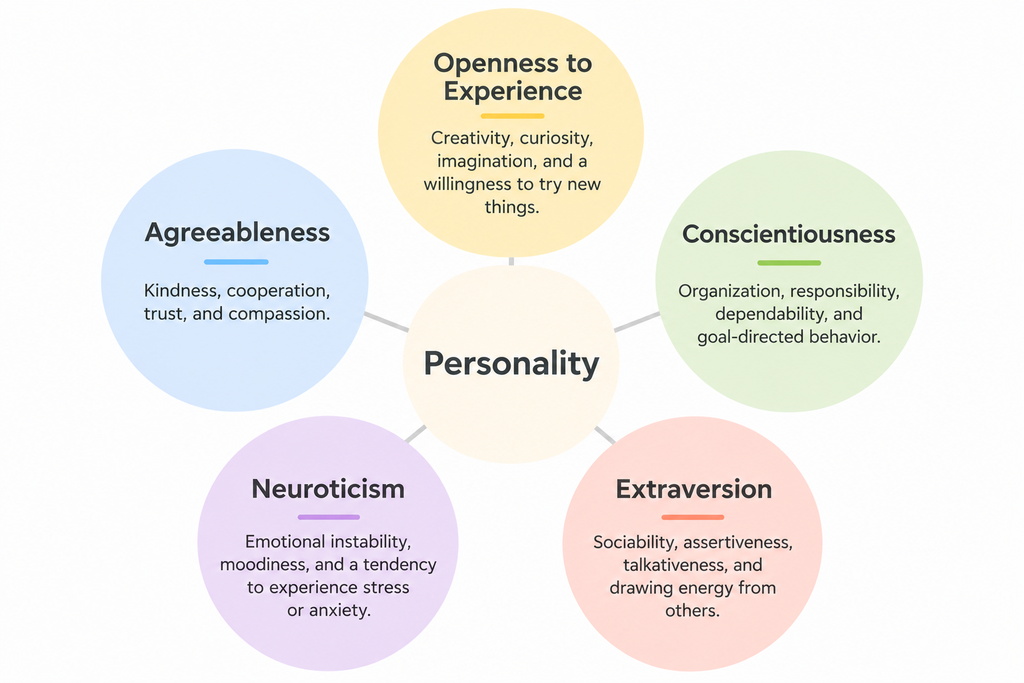
MBTI and the Big Five are closer relatives than they look. When Robert McCrae and Paul Costa compared people’s MBTI results with their Big Five scores, four of the MBTI scales correlated with four of the Big Five traits: extraversion with extraversion, intuition with openness, feeling with agreeableness, and judging with conscientiousness . MBTI never measured neuroticism at all. So it picks up on something real, but its measurement is where it falls apart. Because it splits each scale into two boxes, a person just past the midpoint gets the same letter as someone at the far end, and a small shift on a retake can flip their whole type. The Big Five treats each trait as a spectrum instead, which makes for a less exciting self-introduction but a far more reliable measurement.
In 1968, psychologist Walter Mischel added an important caveat: traits predict behavior in any single situation less well than people assume. Personality sets out a tendency, and context shapes how it shows. The same user may act one way on a crowded train and another on the couch at home, which is why good research watches people in context instead of relying only on what they say.
Where Personality Shows Up in UX
Look at UX through the lens of the Big Five, and you start to see traits influencing both how people use a product and how they judge it. A few areas where this shows up:
People higher in openness tend to search broadly and welcome new ideas, while those lower in openness prefer a few precise results that confirm what they already know. The same discovery experience can excite an explorer and overwhelm someone who just wants a clear answer.
In research of personal website owners invited to an online survey , the people who agreed to take part tended to be more open to experience and more agreeable than those who declined. In other words, the people who volunteer for your study may already be more curious and cooperative, and their feedback may sound friendlier as a result.
Together, these studies show that personality shapes what users do, who shows up, and what they tell you.
The session itself matters too. Extraverted participants may think aloud easily while introverted ones say less, and agreeable participants may soften criticism to stay polite. If your analysis is heavily based on the most talkative voices, your findings can quietly tilt toward one personality style.
When Research Crosses Borders
Imagine you send the same satisfaction survey to users in the United States and Japan, and the Japanese scores come back lower. Are Japanese users less happy with your product? Maybe. But the way people answer questions about themselves varies by culture.
Three habits make comparing scores across countries tricky.
In a study, high school students in Japan and Taiwan chose the middle of rating scales more often than students in the US and Canada, while US students were the most likely to pick the extremes . In Japan, this habit connects to kenkyo, or modesty, so a “3 out of 5” may mean something different than the same number from an American participant., or modesty, so a “3 out of 5” may mean something different than the same number from an American participant.
Japanese distinguishes honne, a person’s true feelings, from tatemae, the face shown in formal settings. An interview with a stranger from a foreign company is about as formal as it gets, so answers may reflect politeness more than real experience.
In a personality and social psychology study , Japanese college students asked to complete “I am ___” listed fewer personality traits than American students did and mentioned their social roles and situations instead. When the question named a specific situation, the pattern reversed: Japanese students described themselves with more personality traits, while Americans started qualifying their answers. For research, that could mean a broad question like “What kind of shopper are you?” may get a vague answer from a Japanese participant, while “How do you shop on your way home from work?” can give you much more to work with.
What This Means for Your Research
The takeaway here isn’t to account for every user’s personality or to give them a personality test. What does matter is what you build and how you read your data once you know how personality shapes behavior and how culture shapes the way people describe themselves. If you’re designing for or researching users in Japan, or comparing them with users elsewhere, a few habits make a big difference:
Give everyone a way to contribute
Mix tasks that require talking out loud with written exercises, diary studies, or observation, so you hear from talkative and quieter participants alike.
Notice who you’re hearing from
If most participants are outgoing early adopters, your findings may reflect one kind of user. Varied recruiting or the TIPI-J can help.
Don’t let the loudest voice steer your findings
How many issues people report depends partly on personality, so one serious problem from a quiet participant can outweigh a long list of minor ones.
Localize your questions and words
Questions can change meaning between languages, and broad questions like “What kind of user are you?” work better in Japan when rewritten around specific situations.
Compare patterns before comparing scores
Japanese participants often choose the middle of rating scales, so a lower average may reflect answering habits. Check patterns within Japan before comparing countries.
Have someone local help interpret the results
People who understand how Japanese participants communicate can help voice when someone is being polite and reading the room, or pointing to a real problem.
Back to Those Four-Lettered MBTI

My ENFJ result said more about me than the test intended: it didn’t measure my personality accurately, but it showed how much I wanted to fit that label. Your users may do something similar in every survey and interview, describing themselves in a way that feels right for that moment and that setting.
Personality psychology helps you read those answers more carefully, and that care matters most across languages and cultures. Helping teams interpret what Japanese users say and do is exactly what we do at Uism. Our team creates sessions where Japanese participants feel comfortable giving honest feedback, adapts surveys and discussion guides so they keep the same nuance across borders, and reads the results with the cultural context that numbers alone can’t provide. If you’re planning research in Japan or trying to make sense of data you’ve already collected, we are here to help.
References:
- Response Style and Cross-Cultural Comparisons of Rating Scales among East Asian and North American Student
- Culture and self-perception in Japan and the United States
- Who are the people reluctant to participate in research? Personality correlates of four different types of nonresponse as inferred from self- and observer ratings
- Otalab (JP)
- Effect of Personality Traits on UX Evaluation Metrics: A Study on Usability Issues, Valence-Arousal and Skin Conductance
- Reinterpreting the Myers-Briggs Type Indicator from the perspective of the five-factor model of personality